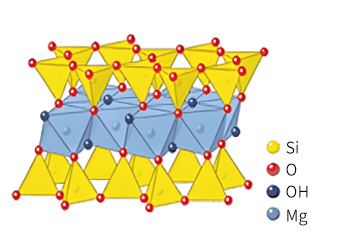
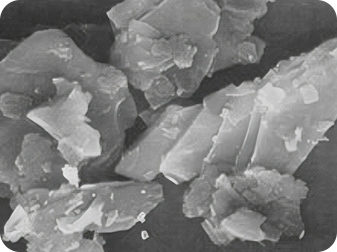
Talc is a typical layered silicate mineral, represented by its oxide composition of 3MgO·4SiO2·H2O. Its chemical composition consists of 31.72% MgO, 63.52% SiO2, and 4.76% H2O. Talc typically exhibits lamellar properties and belongs to the monoclinic crystal system. Its crystals often occur as lamellar, phyllitic, granular, fibrous aggregates, or dense masses. Under mechanical force, these lamellae can easily delaminate into individual sheets. Each sheet comprises two parallel upper and lower surfaces, along with irregular edge surfaces. The parallel surfaces are hydrophobic and oleophilic, while the edge surfaces exhibit oleophobicity and hydrophilicity. The unique lamellar and layered three-dimensional structure of talc powder provides excellent rigidity, creep resistance, and mechanical properties to materials. It enhances the overall performance of materials while reducing costs, making it widely used.

During the Cambrian period, talc deposits began to gradually form in China. The formation conditions are primarily related to the deposition of carbonates during crustal movement, as carbonates are transformed into talc deposits under the influence of hydrothermal fluids.

The concentrations of deposited carbonate, SiO2, and Mg2+ are relatively high.

The mineralization reaction of the Xiajiaozhuo talc deposit in Longsheng, Guangxi, corresponds to the principle of equal volume exchange, with Mg2+ concentration of approximately 60mg/L.

The Longsheng talc deposit in Guangxi is located in this area, which is primarily characterized by fault and cross-accumulation zones. The main part of the deposit is located near this area in the northern part, where it is characterized by a composite overturned dip. The thick layered rock mass underground can serve as a barrier.

 CN